
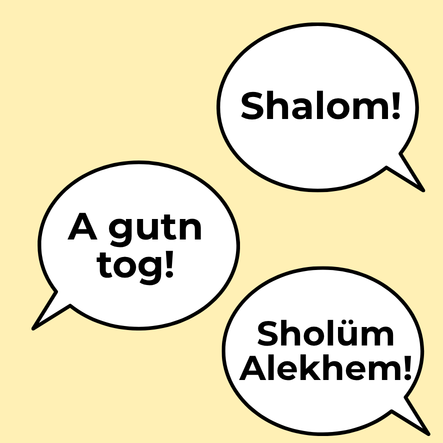
The Ottawa Jewish E-Bulletin’s Ethan Rode is a trained linguist and is passionate about the preservation of minority languages. In this article, he shares his expertise in Jewish languages in honour of Jewish Heritage Month.
By Ethan Rode
“A country without a language is a country without a soul.” These are the words of Irish revolutionary Pádraig Pearse, who used this expression to convey the weight that a native language holds on the morale of a people.
For centuries, Jews have been a multilingual people. We have had many languages that have been spoken, sung, and prayed in. Prior to the revitalization of Modern Hebrew as a spoken language by Eliezer Ben Yehuda in the late 19th century, Jews mostly only used Hebrew for religious contexts and as a lingua franca, or common language, between diaspora communities that spoke different languages from one another.
What was spoken in the home were largely “Jewish languages,” which are unique varieties of local languages that are coloured with bits of Hebrew, Aramaic, and languages of the surrounding non-Jewish population. Some of these Jewish languages are well known, such as Yiddish and Ladino, which are Jewish varieties of German and Spanish, respectively.
Some Jewish languages that you may not have heard of include Yevanic (Judaeo-Greek), Qwara (spoken by some Ethiopian Jews), or Bukharian (Judaeo-Tajik).
Over the millennia, these unique languages developed for many reasons, such as having limited exposure to external non-Jewish communities.
Unfortunately, however, over the last century, all these languages have begun to dwindle. Some have even disappeared entirely.
Yiddish, for example, was spoken by nearly 13 million people on the eve of the Holocaust. Now, there are fewer than 600,000 speakers left. While it’s still alive and well in Hasidic communities, many speakers from other Jewish communities stopped passing the language on so that their children could better assimilate to the surrounding community.
Yevanic, the Judaeo-Greek dialect mentioned above, has very few speakers left, currently estimated to be under 500.
This is the currently state of most Jewish languages, with very few communities having the support or resources to revitalize their languages.
When Hebrew was revitalized, many Jews emigrating to Israel stopped speaking their diasporic tongues, as these were thought to be used as languages of survival. With Modern Hebrew, there was a Jewish language that bound all Jews together, regardless of whether they are Persian Jews or Ethiopian Jews.
While the number of speakers of diaspora languages has been declining over the last century, there are organizations like Hebrew Union College and its Jewish Languages Project which helps to raise awareness of Jewish languages by recording speakers of the language, documenting words, and sharing literature written in the language.
The website has resources for over 30 Jewish languages, housing a vast repository of songs, sayings, and more in both living and extinct languages.
There are also organizations like YIVO and the Autoridad Nasionala del Ladino which aim to support revitalization efforts through children’s programs, cultural events, and publishing books.
Clearly, there are still ways we can all still hold onto our ancestral languages, even if the hope of preserving them feels lost.
For example, words are still being passed on to children and grandchildren.
Many Canadian Jews of Ashkenazi heritage already know many words in Yiddish. Mensch (good person), plotzing (collapsing from extreme emotion), and mishegas (craziness) are ubiquitous in many conversations. Likewise, while Ladino has largely died out among younger Sephardi Jews, some words like kal (synagogue) or guay de mi (Ladino version of ‘oy vey’) have survived into this century.
This demonstrates that these languages still hold meaning in the lives of our people, even if they are no longer the dominant language at home.
It may be worthwhile to reframe how we think of Jewish languages. Rather than thinking of them as ghettoized versions of local languages, they are really living records of where our communities have been, what we endured, and how we carried our traditions across continents and centuries.
Even as some of these languages fade from daily use, they continue to survive in songs, prayers, humour, and the words we pass down within our families. Preserving and celebrating Jewish languages goes beyond saving vocabulary and grammar. It is about ensuring that the stories, cultures, and voices of Jewish communities around the world are not forgotten.
For people who are interested in learning more about Jewish languages, the Jewish Language Project is an incredibly detailed resource full of songs, sayings, and facts. Click here to visit their website.