
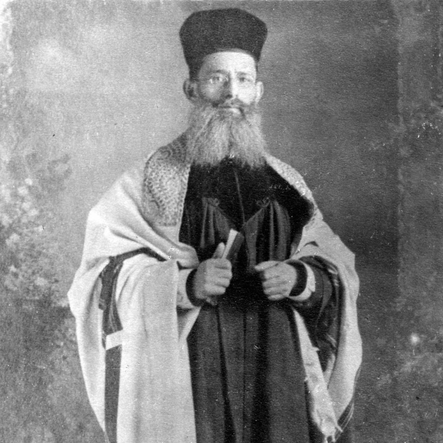
As Ottawa celebrates its 200th anniversary, local historian David C. Martin is hoping to shine a light on a lesser-known part of the city’s history: the foundational role played by its early Jewish community.
Martin is spearheading an effort to have a public space in Ottawa named in honour of Jacob Mirsky, a Jewish community leader who arrived in the city in the 1890s and became a central figure in its small but growing Jewish community.
A trained historian who studied at Carleton University, Martin first became interested in Ottawa’s Jewish history after volunteering at the Ottawa Jewish Archives. He has since written about the history of Congregation Machzikei Hadas and recently joined the Ottawa Jewish Historical Society.
His interest in Jacob Mirsky grew out of his research into the early Jewish community and those who helped establish it.
“When he arrived in Ottawa, the community was really small,” Martin explained. “Local Jewish institutions and congregations were just starting to be established.”
Mirsky became Ottawa’s first permanent Jewish clergyman and served the community for decades. While sources differ on whether he was formally ordained as a rabbi, Martin said Mirsky was trained as a cantor and was a Talmudic scholar.
More significantly, he became a key figure in connecting Ottawa’s Jewish residents with one another.
As waves of Jewish immigrants arrived from Russia around the turn of the 20th century, with many settling in the Lowertown and ByWard Market areas, Mirsky served as a bridge between the established Jewish community and the newcomers.
“He became the core of the Jewish outreach effort,” Martin said.
Despite Mirsky’s importance, there is little visible recognition of his legacy in Ottawa today. Martin hopes to change that by establishing a public commemoration, ideally in Lowertown, where Mirsky lived and where much of Ottawa’s early Jewish community developed.
Martin emphasized that there are many possibilities regarding the ways in which the city can recognize Mirsky. It could be a street name, a park or plaza, or some other appropriate public space.
“My preference would be for it to be in Lowertown since that is where much of his work was done and where the core of the community was located at the time,” Martin said. “I think commemorating that foundational role that Jews had in building Lowertown, out from the ByWard Market and beyond, would be something nice for the community to have.”
Martin’s proposal also serves as an opportunity to highlight the outsized contributions of a community that was relatively small in number.
“The Ottawa Jewish community is notable for how small it was at the time,” he explained. “It was a handful of families, the names of which are still remembered today, that had this outsized impact.”
Martin is currently gathering letters of support from local Jewish leaders and organizations to accompany a formal application. He also encourages community members to demonstrate their support for commemorating Mirsky.
He believes that broad community backing will be important in demonstrating that the proposal represents more than the initiative of a single historian.
The project also takes on added significance during a challenging period for Jewish communities. Honouring early Jewish residents can help remind both Jewish and non-Jewish Ottawans that the city’s Jewish community has deep roots here and has helped shape the community we know and love today.
“I think at this particular moment for the Jewish community, it might be good to remind the people we live alongside that we do belong, have belonged, and that we’ve contributed so much to this city,” Martin said. “Jewish residents have been a part of the fabric of Ottawa for at least the last 150 of the city’s 200 years.”
For those interested in writing a letter of support to help make this commemoration come to fruition, Martin asks that they are sent to him by Tuesday, October 6, to give him enough time to assemble and complete the application package. Please send your letters to [email protected].