
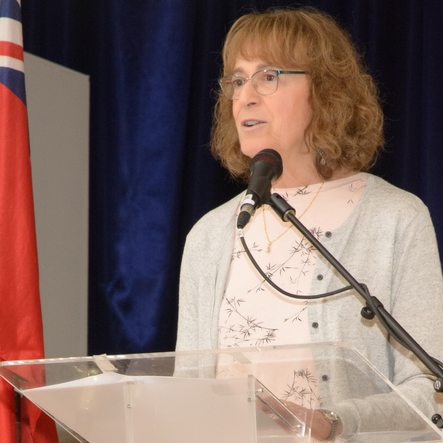
At the Jewish Federation of Ottawa’s annual Yom HaShoah Community Commemoration, award-winning novelist Kathy Kacer spoke about her life as the child of Holocaust survivors and how it inspired her to embark on a second career as an author following her time working as a psychologist.
Having written many stories, like The Secret of Gabi’s Dresser, Hiding Edith, and more, her books have touched the lives of many over the years.
Now, her books will be reaching even more young minds. Thanks to Liberation75, an organization that has been working with the Ontario government to pass legislation to mandate Holocaust education beginning in Grade 6, nearly 80,000 copies of her book To Hope and Back: The Story of the St. Louis have been distributed to across the province.
Kacer recently spoke to the Ottawa Jewish E-Bulletin to talk more about her life, her work, and more about how her book will be utilized in Ontario classrooms.
E-Bulletin: What inspired you to start telling stories about the Holocaust?
Kathy Kacer: I am the child of Holocaust survivors, and I grew up in a family that spoke quite openly about their Holocaust experiences. I was raised on those stories, and I always loved to write.
I first became a psychologist and worked in that field for over 20 years, and then I just kept thinking about the stories that my parents and their friends had told me and decided I would try my hand at putting those stories into writing. I knew I wanted to write for a young audience in the same way that I was young when the stories were told to me. I thought I could then tell them in a similar way to other young people, including my own children who were young at the time.
I first wrote about my mother in hiding, which was a story that was quite prominent in my life when I was growing up, and sent it out to a million publishers. I got a whole bunch of rejections and then heard from one interested publisher. After that, it sort of just became a snowball. I started working on the second book I wanted to write even before that first book, which was called The Secret of Gabi's Dresser, was published.
E-Bulletin: Can you speak about your book that is being used as required reading for Ontario Grade 6 students?
Kathy Kacer: Liberation75, which is a wonderful organization promoting Holocaust education across Canada and the U.S., had been working with the Ontario government to try to pass legislation that would mandate Holocaust education to begin in Grade 6. It took years for that to happen.
When that legislation was enacted, Liberation75 wanted to add a book that would be a resource in the classrooms for the Grade 6 teachers who were beginning to teach in that grade, and they suggested my book To Hope and Back: The Journey of the St. Louis, which tells the story of two survivors who were passengers on board the St. Louis. [In 1939, the ship MS St. Louis carried more than 900 Jewish refugees fleeing Nazi Germany, but they were denied entry to Cuba, the United States, and Canada. Forced to return to Europe, many passengers were later murdered in the Holocaust, making the incident a lasting symbol of antisemitism.]
The book also worked because it shares a bit about Canadian history and its decision to deny entry to the St. Louis, which is an important piece of history that we always need to acknowledge and take responsibility for. To date, nearly 80,000 copies of the book have been distributed across the province. It's an amazing achievement for Liberation75. It's also an amazing achievement for the provincial government of the day, and I'm honoured that my book is the one that so many grade 6 students are reading.
E-Bulletin: What goes into your research process for writing these stories?
Kathy Kacer: I love doing research about Holocaust history. Sometimes, I try to convince myself that I'm writing when I'm just doing research.
Where possible, I love to interview people who are closely related to a specific historical moment. For To Hope and Back, I was able to interview both Lisa and Saul, the two people who were passengers on board the ship, and hear their stories coming from their mouths. That's probably the best research that I can do where possible. In some cases, I've had to interview the children of those who were directly involved in that history. While it’s certainly better than nothing, it doesn't replace the survivor.
I also read voraciously about the St. Louis when I was young and read historical documents about the ship. I was quite fascinated by it. I watched the movies that were being made at that time about it, like Voyage of the Damned.
E-Bulletin: How do your stories help keep the stories of the Holocaust relevant to today? What context do your stories provide for that moment in our collective history?
Kathy Kacer: Holocaust literature across the board is incredibly important, partly because so many of the survivors have passed away. Those first-hand accounts are disappearing. We're transitioning from these historical accounts to recorded memory of that time, so that makes it more important to keep those stories alive long after those who experience that history are gone.
As antisemitism has surged in the last years, along with Holocaust denial, it is important to tell the story of these individuals who fought and struggled to survive. My story tells the story of a heroic figure, the captain of the ship, who was one of those incredible people who, despite the dangers to himself, decided that he would do everything in his power to try and protect the passengers on his ship.
We know that there were not enough people like this captain who was willing to risk his safety for Jews that he didn't even know, never mind your Jewish friends and neighbours. These were strangers to him, and yet he was one of those individuals who wanted to help. Many years later, he was named Righteous Among the Nations, as an acknowledgement for what he did at that time. All of those reasons continue to make this book a relevant one in classrooms.
When I speak to young people, I always ask them to think about their own lives and the choices that they will make as they grow up. Who will they stand up for? What will they stand up for? Will they speak up when they see injustice in their communities, in their neighbourhoods, or in their schools? Will they make a choice to be that kind of person that helps?
To learn more about Kathy Kacer and her books, you can visit her website here. If you missed Federation’s Yom HaShoah Community Commemoration, you can watch the full recording of it, including Kathy’s talk, by clicking here.