
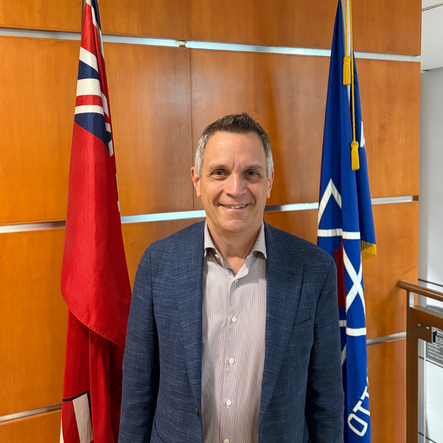
Earlier this month, Mayor Mark Sutcliffe attended a roundtable hosted by the Jewish Federation of Ottawa to discuss what a second term would look like if he were to be re-elected in the upcoming municipal election on October 26.
Speaking to Federation’s Director of Advocacy and Government Relations David Sachs, Chair of the Board Danya Vered, Board member and chair of the Communications and Community Relations Committee (CCRC) Elissa Lieff, and Ottawa Jewish E-Bulletin writer Ethan Rode, he was posed questions about his platform, as well as about issues that are top of mind for Jewish people in Ottawa right now.
Sutcliffe, who has been the Mayor of Ottawa since 2022, has built his platform around affordability, improving infrastructure, and supporting Ottawa’s most vulnerable.
He says he will endeavour to strike a balance between protecting affordability and providing reliably low tax increases and reducing other costs, such as freezing recreation fees. He also says he will lower the cost of a monthly transit pass to $95, which would be the lowest of any major city in Canada.
Furthermore, he said that under his leadership he would continue investing in improving roads and sidewalks, supportive housing, and better public transit. Another one of his goals is to end youth homelessness by 2030, raising money through various charitable organizations in Ottawa to help make this happen.
Regarding issues that are particularly pertinent to the Ottawa Jewish community, Sutcliffe was first asked about security and how the city under his leadership would push back against antisemitism and violent forms of antizionism to help create a safe and secure Jewish community.
“We must continue the work we started together with the faith leader’s council,” he said. “Policing is a part of the solution, as well … I intend to hire more police officers and dedicate some of those additional hires to the anti-hate crimes unit.”
Sutcliffe expressed an openness to continue the work that was started during his first term, including through his City of Kindness initiative, which brought diverse groups together to destigmatize intercommunal differences.
“We need to build a society where fewer people find themselves in that situation where … they want to lash out at the world,” he said.
Regarding the Safe Access By-law, also known as the “bubble by-law,” Sutcliffe reiterated his position on it, stating that he had been a strong supporter of it from the get-go and, if re-elected, will continue to defend it.
“I was a champion of [the bylaw] and led the effort to make it happen,” he said. “I devoted a considerable amount of time, energy and resources in my office to make it happen.”
Related to responding to antisemitism, Sutcliffe was asked about what role he believes the city should play in ensuring that its agencies, programs, and civic institutions are equipped to recognize, prevent, and respond effectively to antisemitism.
“One of the reflections I had after the City of Kindness Summit was that I think there’s an opportunity … to engage more deeply into the organization of the City of Ottawa,” he explained. “What we did with the summit was demonstrate the commitment of the leadership of the city to building a kinder, more open place to live.”
With city council calling for a greater emphasis on antisemitism back in 2023 and incorporating it into the city’s anti-racism framework, the city has still not yet adopted the International Holocaust Remembrance Alliance’s (IHRA) definition of antisemitism, which includes conflating all Jewish people with the actions of the Israeli government as well as Holocaust denial.
This definition has been adopted by the federal government, as well as by the province of Ontario.
“Because we are a creature of the province, we have, by virtue of that, adopted the definition as well,” Sutcliffe explained. “I support that definition and have no objections to the city supporting it.”
Sutcliffe also said he would oppose efforts to bring international campaigns into city politics, such as the Boycott, Divestment, and Sanctions (BDS) movement, and that he doesn’t want to stop flag raisings hosted by diplomatic missions at City Hall.
“It’s a very positive thing that we have a city where all the countries of the world are represented,” he said. “That’s one of the things that makes Ottawa great.”
Regarding support for social services such as Jewish Family Services (JFS), Sutcliffe was asked about the role the city will play in helping agencies continue being able to work at capacity in the face of increasing demand.
While JFS has received municipal grants in the past, it is often not sufficient in addressing the growing need of their services.
“One of the things I would like to do is … multi-year budgeting where we could potentially be making commitments of longer than one- or two-year programs,” Sutcliffe explained. “The budget would still need to be approved every year, but it could open doors to signing multi-year funding agreements with organizations like JFS.”
Sutcliffe said that if he were re-elected, he would continue conversations with both the province and the federal government about securing Ottawa’s fair share of funding so that the city can partner with local agencies to increase programming to support the city’s growing population.
To learn more about Mark Sutcliffe and his campaign, click here.