
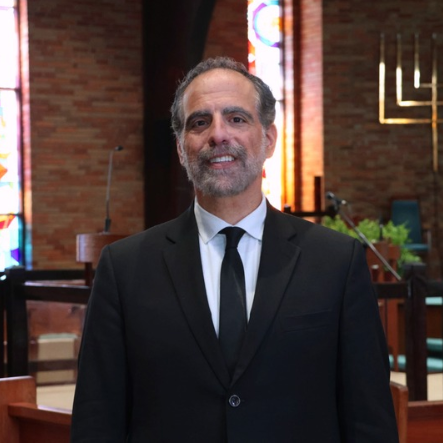
Kehillat Beth Israel (KBI) recently welcomed Rabbi Kliel Rose, who began his tenure at the synagogue a few weeks ago.
The Ottawa Jewish E-Bulletin sat down with Rabbi Rose to learn more about his background, what brought him to Ottawa and his hopes for the congregation.
E-Bulletin: Where are you from originally? Where did you grow up and what led you down the path of becoming a rabbi?
Rabbi Rose: My parents moved to Winnipeg from the United States in 1967, and then my dad, who was both a rabbi and a professor of Jewish studies, was offered fellowship grants to go to Israel in 1970. They ended up staying there for two years with my older brothers, and then I was born there.
Ultimately, we moved back to Winnipeg where my dad continued to work as a professor at the University of Manitoba. I left there when I was about 21 and spent time in Philadelphia, then in Israel, and then in Long Island, after which I started rabbinical school, where I studied for six years.
I grew up in a rabbinic family, an observant home, and I attended an Orthodox synagogue for most of my childhood. Even though my parents were certainly on the more progressive end of Jewish life, that wasn’t necessarily the case in terms of their religious practice. Both my parents are Jewish educators and important models in many ways.
I’ve worked in various places as a rabbi. My first position was part of a fellowship at Congregation B’nai Jeshurun in Manhattan, which I held during my last year of rabbinical school and then my first year out of school as a full-time rabbinic fellow.
My first experience as a congregational rabbi was in Miami Beach, Florida, and then I served a congregation in Nashville, Tennessee, then in Edmonton, and then I’ve been serving for the last eight years in Winnipeg.
E-Bulletin: What are you most looking forward to about coming to Ottawa and to KBI?
Rabbi Rose: My wife, Dorit, and I were particularly drawn to KBI because of how vibrant the congregation is, as well as its combination of a deep commitment to Jewish tradition, halacha, and meaningful prayer, alongside egalitarianism and openness to the wider world.
I was also struck by the pride people take in the congregation and the extraordinary level of lay involvement.
I think there is also a genuine desire to be reflective and to see what the ways are in which we now need to shift and adapt to the changing realities of the world, certainly from a Jewish perspective, but also from society at large and how that impacts Jewish life and congregational life.
We’re living in a post-October 7 world, and the Jewish community in Canada is facing profound challenges. For me, the question is not simply how we respond to antisemitism, but how we strengthen our Jewish identities, deepen our spiritual lives, and find meaning and purpose in Jewish tradition during this difficult moment.
Something else I really appreciate about KBI is the folks here are deeply tied to Jewish tradition. It really is the best of what I think a Conservative congregation can be: the tie to traditional customs and halacha, and also the want to balance that with an appreciation of being worldly and an egalitarian congregation, in every sense of the word.
In terms of Ottawa, there’s so much I’d like to be able to see. Outside of New York and Philadelphia, I haven’t lived in the northeast of the continent, so culturally it’s a change for me.
I’m excited to be in Canada’s capital. Being here provides an important opportunity to build relationships with elected officials, advocate for the Jewish community, and contribute to the broader civic conversation. I see this as part of our responsibility as Jewish leaders and an expression of kiddush Hashem, or sanctifying G-d’s name.
E-Bulletin: What have your first moments in Ottawa been like? What are your first impressions?
Rabbi Rose: I can’t speak enough about the level of praise I have for the leadership of KBI, both on the professional and lay level, for the way they have embraced me and my family. My wife arrived about a month or so before I did, since I was finishing my time in Winnipeg through the High Holidays. The congregation has just been so loving of her and the three of our five kids who are here with us in Ottawa now.
I’ve also been communicating with lay leaders and professionals for several months, well before I started officially. Those first impressions have been great. I love the fact that KBI takes halacha and prayer seriously, so I’ve been a part of minyan on a regular basis.
Somebody who was very dear to me in Winnipeg had been battling cancer and was reaching the end stage of it, and one of her wishes was for me to be able to officiate [the funeral]. She passed shortly after I arrived in Ottawa, and I had expressed the dilemma I was in to the leadership, and they were so supportive of me being able to go back and doing that.
E-Bulletin: What are your goals in this new role?
Rabbi Rose: My hope is to build on KBI's many strengths while creating a congregation where people of every generation feel a genuine sense of belonging. I want KBI to be a place where people can find community, spiritual meaning, opportunities for learning, and a deeper connection to Jewish life.
There is also a deep desire from leadership and the general membership for KBI to be seen as an open facility for all, so I invite people to come and see what it’s like to be here on Shabbat to get a feel for what the congregation has to offer.
Rabbi Rose is looking forward to meeting people in the community and at KBI. To reach him, you can send an email to [email protected].
Also, KBI will soon be celebrating its 10th anniversary, kicking off this weekend on Sunday, November 8 with Open Doors, Living Books, where attendees will have the opportunity to learn about various community members and KBI staff, including Rabbi Rose. To learn more about that event, click here.