
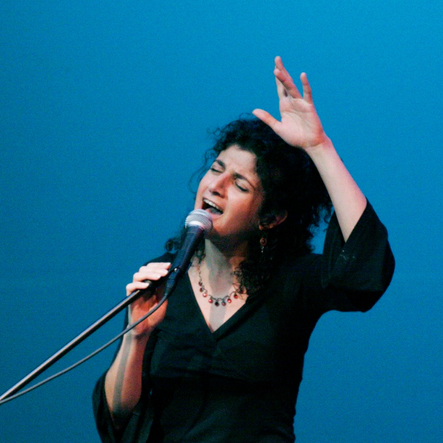
-- Photo credit: Janice Rubin
Galeet Dardashti is an Iranian Jewish anthropologist and singer who beautifully weaves together her musical heritage with storytelling. Based in New York, she travels around the world studying Sephardi and Mizrahi liturgical music, as well as Middle Eastern music more broadly.
Coming from a long legacy of singers, she is the daughter of a cantor and granddaughter of an Iranian classical singer who was considered “the nightingale of Iran.”
Soon, Dardashti will be making her way to Ottawa to perform a special program about her family’s story at the Soloway JCC. To help mark Jewish Heritage Month, the Ottawa Jewish E-Bulletin caught up with her to learn more about how she celebrates both her Jewish and Iranian heritages in her work, as well as what concertgoers can expect from her performance.
E-Bulletin: How do your Jewish and Iranian heritages intersect in your life?
Dardashti: My Iranian identity was very much a conscious choice for me to embrace, because I didn’t grow up with a very strong Iranian connection. I was raised in the United States by an Iranian father, who immigrated there when he was 19. He became a cantor, but in the Ashkenazi style.
So many of us have these complex “Jewish and” identities. We don’t always talk about them. We are just put into categories like ‘Iranian,’ or ‘Moroccan,’ or ‘Iraqi.’ Our identities are so much more complicated than that, particularly for Jews of Sephardi or Mizrahi extraction living in North America.
I wasn’t raised in Persian traditions; I grew up in a completely Ashkenazi environment, so I had to make the conscious choice to learn more about the incredible Persian legacy that I’m a part of. My dad was happy to share all his knowledge with me, but only when I asked.
My grandfather, Younes Dardashti, was one of the most famous singers of Persian classical music. He was considered ‘the nightingale of Iran’ and was adored by all Iranians, regardless of their religion.
All of this inspired me to study Persian classical music and to really appreciate this part of my identity.
E-Bulletin: Coming from such a storied legacy of singers, is this what inspired you to get into music?
Dardashti: My parents were already performing together before they were dating, and so when my sisters and I were born, we joined the act.
It was just so natural to me. Being on stage was almost like breathing for me. When I was just three years old, I was already singing harmony with my sister on stage at one of my dad’s concerts, so music was already such a big part of my life back then. Since my parents were both musicians, we started performing together as the Dardashti family, so that’s how I became comfortable with performing.
We really didn’t sing any Persian music when I was growing up; it was all Ashkenazi, except for one Persian song that my dad would sing at Yom Kippur.
Later, music became more of an academic pursuit and my focus as an anthropology student. During my studies, I immersed myself in various cultures and the ways in which they make music.
I studied Middle Eastern music with singer Yair Dalal in Israel, who then helped me find a Persian music teacher, and continued my field work there. Unfortunately, I wasn’t able to get to Iran, so most of my studies revolved around Mizrahi culture in Israel and the musical movements happening there.
E-Bulletin: What inspired you to pursue anthropology?
Dardashti: I didn’t have family members that came from the academic world, but I was so interested in culture. While I was an undergrad, I was an English major and took a class on Caribbean literature. For one of my papers in that class, I decided to write about Caribbean music, and it was so exciting.
Later on, another student and I performed Caribbean music in that class. I remember it being so fun to get into the culture I was studying. This is what sparked my love of anthropology.
My mom was influenced by the likes of Joan Baez and Pete Seeger, who both sang folk songs from various cultures. Growing up around that music also helped to instil a love of music and culture.
When I went to Israel in my [third year of university], I had no idea who Mizrahim were. I never really knew about the experience of Jews from the Middle East and North Africa.
E-Bulletin: With everything happening in the world right now, between rising antisemitism and war in Iran, how are you coping? How are you finding comfort in connecting to the Jewish and Iranian communities?
Dardashti: The main thing that gives me comfort is the work that I do. Being able to remind people that there was a time in history when Jews thrived in Iran, and Iran and Israel weren’t enemies. Being able to tell my family’s story has been helpful for me during this time, reminding people that history isn’t linear, and that there are models for how people coexisted.
E-Bulletin: You will soon be giving a concert at the Soloway JCC. What can the audience expect from your performance?
Dardashti: This performance, The Nightingale of Iran, is going to tell the story of my family. They’re going to hear the story of our grandfather, our father, and of us, too, as immigrants. The story is about immigration and the complex stories that arise from that. The audience can also expect to hear stories of friendship between Jews and Muslims in Iran.
There will be a visual component to the performance, where they’ll be able to see some of our story play out on the screen.
If you’re interested in learning more about Galeet Dardashti, you can visit her website here. She will be performing at the Soloway JCC on Wednesday, May 27 at 7 p.m. Click here to purchase tickets.